
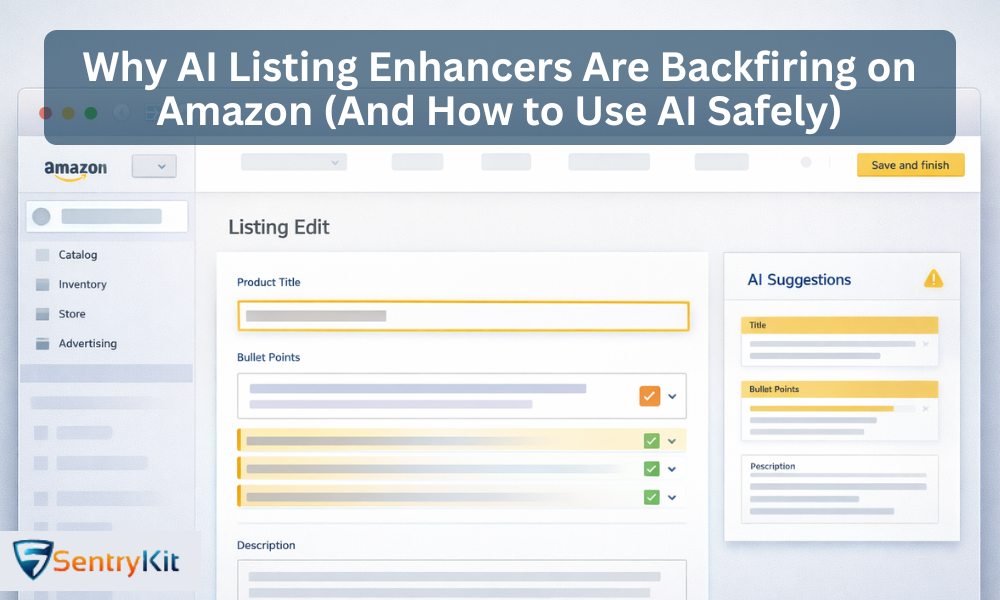
Amazon’s native AI listing enhancer—built directly into Seller Central—has quickly become a go-to option for sellers looking to optimize listings, scale faster, and reduce manual effort. From AI-generated titles to automated bullet points and keyword-stuffed descriptions, AI listing enhancers promise efficiency and growth.
But in 2025, many sellers are discovering the downside.
Instead of higher rankings and conversions, sellers are facing:
Listing suppressions
Policy warnings
Sudden traffic drops
This article explains why Amazon’s default AI listing enhancer is backfiring for many sellers, how Amazon evaluates AI-generated content internally, and—most importantly—how to use AI safely and responsibly without putting your seller account at risk.
Amazon’s AI listing enhancer is a built-in Seller Central feature that automatically generates or modifies listing content using artificial intelligence. These tools typically optimize:
Product titles
Bullet points
Descriptions and A+ content
Backend search terms
Pricing or competitive positioning (when paired with repricing logic)
Unlike third-party tools, Amazon’s default AI enhancer operates within Seller Central and can apply suggestions directly—sometimes without sellers fully understanding the downstream impact.
Used correctly, AI can save time and improve consistency. Used incorrectly, it can trigger Amazon’s enforcement systems.
Amazon’s marketplace has evolved dramatically. While AI tools have improved, so has Amazon’s ability to detect manipulation, duplication, and non-compliant behavior.
Here’s why many AI listing enhancers are now causing more harm than good.
One of the most common problems with AI listing enhancers is keyword overuse.
Many tools:
Repeat the same keywords unnaturally
Stuff titles and bullets for SEO rather than readability
Ignore Amazon’s style and formatting guidelines
Amazon’s systems now prioritize clarity, relevance, and customer experience. Listings that look algorithmically generated—or excessively optimized—are more likely to be flagged or suppressed.
AI tools often reuse similar phrasing across multiple listings.
This creates:
Near-duplicate content
Thin differentiation between ASINs
Signals of automated listing manipulation
Amazon’s content moderation systems are designed to detect patterns. When multiple listings look mechanically similar, AI listing enhancers can unintentionally raise red flags.
Most AI listing enhancers are not fully aligned with Amazon’s constantly changing policies.
This leads to issues such as:
Prohibited claims (medical, performance, guarantees)
Restricted keyword usage
Improper comparisons or superlatives
Amazon doesn’t penalize the tool—it penalizes the seller.
Bulk updates are another major issue.
When AI listing enhancers push large-scale changes across dozens—or hundreds—of ASINs at once, Amazon may interpret this as suspicious behavior.
Common consequences include:
Temporary listing suppression
Buy Box instability
Manual review flags
Gradual, monitored updates are far safer than mass automation.
AI tools optimize based on patterns—not real customer feedback.
This can result in:
Generic bullet points
Missed objections
Reduced conversion rates
When conversions drop, Amazon’s algorithm responds accordingly—regardless of how “optimized” the content looks.
From a buyer’s perspective, poorly implemented AI listing enhancers often create:
Robotic or repetitive language
Confusing feature lists
Overpromising claims
This leads to:
Negative feedback
Returns
A-to-Z claims
All of which indirectly impact account health and listing performance.
AI itself is not the problem. Uncontrolled automation is.
Here’s how sellers can use AI listing enhancers responsibly in 2025.
The safest approach is human-in-the-loop optimization.
Best practice:
Let AI suggest content
Manually review for policy compliance
Edit for brand voice and clarity
AI should support decision-making, not replace it.
Before publishing AI-generated content:
Review Amazon category style guides
Remove claims AI cannot substantiate
Avoid superlatives like “best,” “guaranteed,” or “#1” unless verified
Amazon Seller Central’s help documentation should always be your final reference.
Instead of bulk updates:
Test AI-enhanced content on a few ASINs
Monitor performance and compliance alerts
Expand only after confirming stability
This minimizes the risk of mass suppression.
One of the biggest mistakes sellers make is failing to monitor what happens after AI updates go live.
Using an Amazon listing monitoring tool allows sellers to:
Track unexpected listing edits
Detect suppressions early
Monitor Buy Box and content changes
👉 Learn more on our Amazon account monitoring tool page.
Not all AI tools carry the same level of risk.
While Amazon’s AI content automation can trigger listing and policy issues, smart repricers operate within Amazon’s pricing rules and focus on competitiveness—not content manipulation.
A well-designed AI-powered repricer:
Adjusts prices dynamically based on market conditions
Respects minimum and maximum price limits
Helps maintain Buy Box eligibility
When paired with monitoring and alerts, smart repricing can improve profitability without risking compliance.
👉 Explore how intelligent pricing tools fit into a safer Amazon optimization strategy on our repricing and monitoring solutions page.
AI listing enhancers often fail silently.
By the time sellers notice traffic drops, the damage is already done.
Real-time alerts help sellers catch:
Listing suppressions
Policy warnings
Unexpected content changes
👉 See how proactive alerts protect sellers on our Amazon alerts system page.
No—but they should use them with caution.
The sellers succeeding with AI in 2025:
Use AI selectively
Monitor results continuously
Combine automation with human oversight
Focus on customer clarity over keyword density
AI is a powerful tool—but Amazon still rewards trust, compliance, and customer experience above all else.
I listing enhancers aren’t inherently bad—but unchecked automation can quietly hurt sellers.
By using AI responsibly, monitoring listings closely, and pairing content tools with safe automation like smart repricers, sellers can scale without triggering Amazon’s enforcement systems.
The future of Amazon selling isn’t about replacing humans with AI—it’s about using AI intelligently, transparently, and safely.
If you want to protect your listings while still leveraging automation, explore our Amazon monitoring, alerts, and smart repricing solutions designed for sellers who value long-term stability.
For the latest policies and listing guidelines, always refer to Amazon Seller Central’s official documentation.